Tuesday, July 2, 2013

Lecce - A Wonderful Surprise

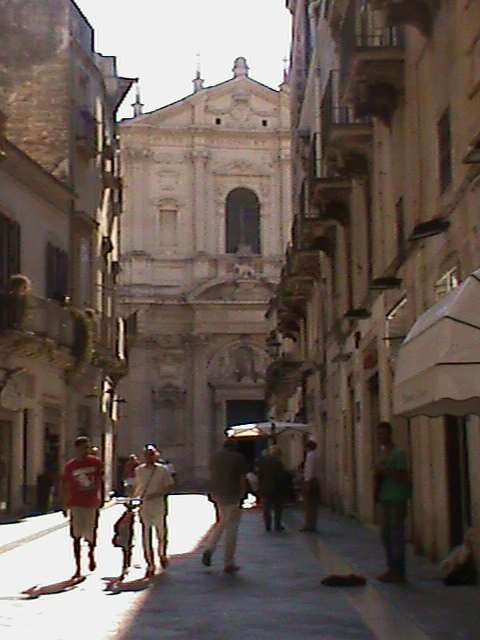
     I love nice surprises.  The next day we were transported to the town of Lecce.  Lecce is a university town of 90,000 + citizens, yet, it has a slow graceful feel to it. The town name is pronounced lay chay

     We were taken to the Patria Palace Hotel, a 5-star hotel in the middle of the historic district. Wow!  The rooms have frescos painted into the plaster on the walls.  Mine was a seascape - which I forgot to photograph.

     It was getting near 1 pm - the start of the siesta when all shops, etc., close down for three hours.  I took a nap.  When I woke up, I decided it was time to go exploring.

Baroque

    Lecce is very much a Baroque city.  Baroque is type of artistic expression that started in Rome in the 1600s, and spread throughout Europe.  It has large sweeping movements, emotional elements and bigger than life aspects to it.  A piece of Baroque music we are all familiar with is Pachelbel's Cannon in D Major.  Trust me, you have all heard this piece of music, even if you don't know its name.

    The city is also filled with churches, Greek and Roman ruins, and palaces.  Given that I only had one afternoon and evening, I had to choose carefully.

Four Churches

    I needed a new watch battery, and the hotel staff were able to send me to a shop near an ancient amphitheater.


Look close enough and you will see the Golden Arches!
Saint Oronzo presides over the square that carries his name

    The shop and ruins are located in Piazza Saint Oronzo.  I walked around and found a bookstore.  I was hoping that I would find Italian versions of the children's classic Strega Nona  which takes place in Italy.  They did not have these books, alas. But the store did have a large selection of vampire romance novels including the Twilight series.  The covers were in English, but the text was in Italian.  I did find this book - see if you can tell what it is about - I was able to read some of it, and I am hoping there might be an English edition.


     Next to the book store was a McDonald's!  I looked in to see if they had McPizza - not that I would buy that, but I was curious.  McPizza is made here in the states - in Utah!  I was going to go on my way when I saw a little nun coming out of McDs with her hamburger, fries, and shake!  Well, if the nuns ate there......I was hungry, so I got a burger.  What intrigued me was how many Italians were swarming the place, and how many children wanted the icky soft serve ice cream that McDonald's serves!  I had been told by my concierge of the best gelato place - across the square.  I just didn't get it.  Why have soft serve when you could have authentic Italian gelato (which is literally Italian for ice cream)?  I opted for the Italian version and was not disappointed in my choices of chocolate and lemon.  Seriously, I don't eat at McDonald's stateside, and I can't tell you the last time I ate there before Italy.  Probably when I lived in Turkey - over a decade ago.

     Now, I was going to explore churches.  Some would say that once you've been in one church, you have pretty much seen them all.  This is just not true!  The first church I went to was Chiesa Del Gesu O Del Buon Consiglio, (Church of Jesus of Good Counsel), which was built in the 1500s under the Jesuit priest Bernardino Realino, whose relics are in the church.  He was later made a saint.


The remains of St.Bernardino Realino


The next church was the Basilica De Santa Croce (Sacred Cross), which was literally across the street from my hotel.  This church dates from the 1600s  There is restoration work being done on the outside, hence the scaffolding.


Attached to Santa Croce are governmental offices, but this used to be the Celestine Monastery.

The ceiling of Santa Croce


With the sunset, one side of the church was had more light than the other.


While in Santa Croce, I lit a candle for my late sister-in-law, Linda Williams, who had passed away.
She had been born a Catholic, so I thought it appropriate.


   I wanted to visit the Greek Orthodox Church which dates from the 1700s, but it was closed.


   Next was the Church of Santa Angelo which dates from the 1600s.


I was not able to find out who this nun was.  I am guessing that she was
made a saint if her portrait is life size in a church.


     My final visit was to the Church of the Alcantarines,  Chiesa di Santa Maria Provvidenza O Delle Alcantarine, which dates from the 1700s.   The Alcantarines were a distinct group of Franciscan monks from Spain who wore only sandals, or most likely, went barefoot as a show of humility.

    ,
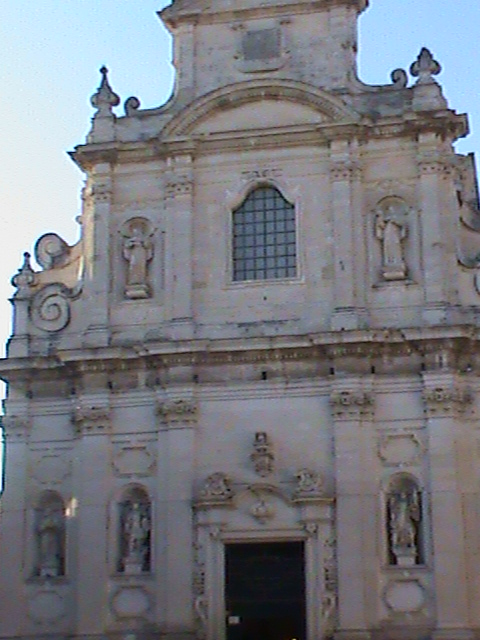


     Lecce is a beautiful city, and I would love to return.


The Salentine Peninsula

   Our last day of riding would be along the coast at the bottom of the heel of the boot - the Salentine Peninsula.  Unfortunately, my lungs had other plans - damn them!

   I had ridden about 10 km, when I had to stop for a breather.  Our rider that day, Fabio, was with me the entire time, and would encourage me with "You can do it!"  We rode more slowly than the rest, but that was okay.  After another rest, I had ridden about 20 feet when I started a full attack that required my rescue inhaler.  Fabio quickly got on the phone and had Gigi come back for me.  I was so disappointed, and so mad at my body for failing me.

   Gigi and I would meet the rest at a small town for a quick snack, and then on to the town of Castro Marina, where he and Fabio would lay out a lovely picnic lunch for us.  The next two pictures are from Castro Marina.


     After lunch, the rest would have the massive hill that this trip provided.  So, Jean opted to ride with me until the top of the hill, then she would ride her bike the rest of the day.  I was so jealous that this 84-year-old woman could out ride me!  But, she and her husband, David, give me a goal to reach - riding bikes when I am in my 80s!

    In the afternoon we would stop at a cove for a swim.  I didn't swim, but I enjoyed the shade, and the Schweppes Lemon drink I was able to procure.  Lemon Schweppes - my newest love!


Italian Women

   So, here I am on the beach with these gorgeous Italian women in their swimsuits and bikinis.  American women have such stupid beauty pressures to live up to.  Well, guess what?  Italian women have cellulite, post pregnancy bellies, and bits of jiggly fat!  They just don't care when it comes to the beach!  More power to them!


 That evening was our farewell dinner with our group and our guides.  The next day we would leave for the city of Lecce and Gigi and Fabio would leave us.  Gigi was finished as a guide for the next two months.  Fabio had one more group to guide.  The Puglia trip is not available in July or August due to heat.


Sunset at the Masseria

On to Otranto

   The next day we left Ostuni for the small village of Melpignano.  From here we would ride to the port city of Otranto.  Having gotten a reply from my doctor, I was ready to ride.  I would have to restrict how many kilometers I rode.  So, I would ride to Otranto and stop for the day while the rest of the group would ride on to our next masseria, a few kilometers outside Otranto.


Spiaggia is Italian for beach.  A few of my group actually went swimming
and said the water was as warm as bath water.

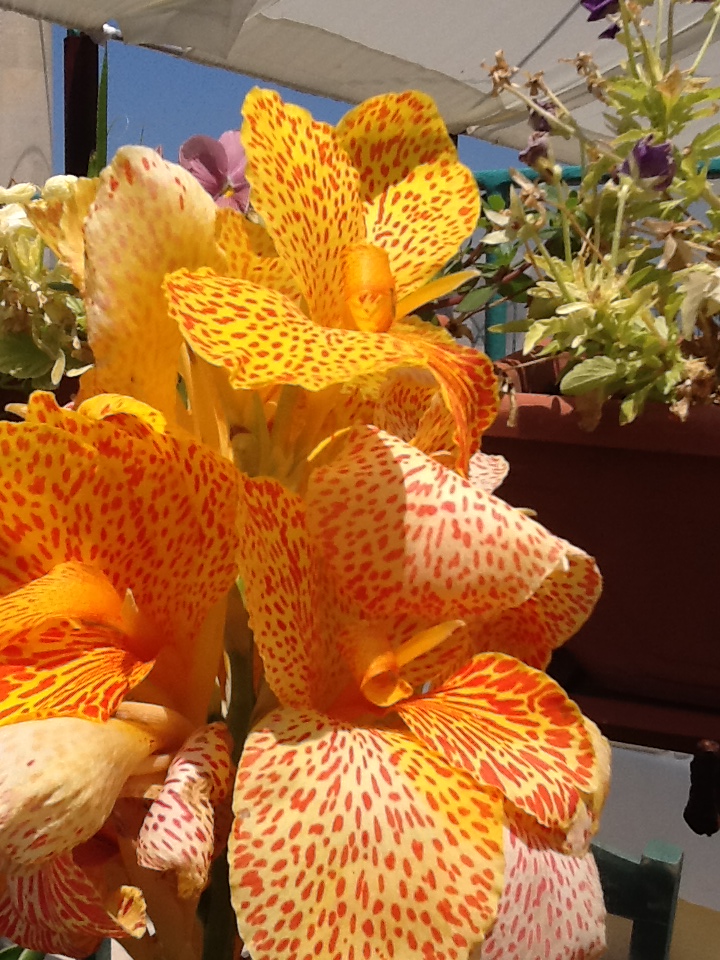
At first I thought this was a variety of iris I had not seen before.
It was not an iris, but I thought it pretty.


   The Madonna Above the Sea chapel is a small chapel near the port.
 It has sea-themed décor.


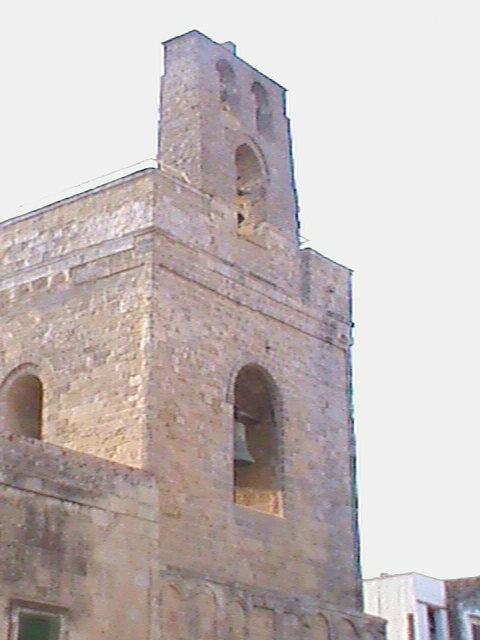
I had to do a zoom with my camera to get this bell tower.


The older part of Otranto


      In the afternoon we were taken to our new masseria, our home for the next two nights. We would stay at Maseria Montelauro, which our guide, Fabio, says is his favorite masseria.  He thinks it is more authentic.  I think he likes it because of the animals!  They have a donkey, two miniature ponies, and a variety of elderly dogs.  The owners have a kind of animal sanctuary going on.


I can't remember his name!  He was a friendly donkey and came when you called him.

Pallanino, little ball, was the larger of the miniature ponies.  The other, Rocco, was quite small.
He didn't photograph well, so I can't include him here.

Jasmine

This flower was so pretty in the sunset.


The door to my room.


Because the walls of our rooms were so think, the only way we could get internet access was to step
 outside on the patio.  Not a bad way to check on home. It was here that I learned my sister-in-law,
Linda Williams, had succumbed to lung cancer.  While I was in luxurious surroundings, I was still deep in
the countryside.  The masseria staff was very good about getting me on the phone with Delta Airlines,
however, I would not get back in time for her funeral.

 
Storia - Italian for History

     Otranto now has a population of about 6,000 permanent residents.  For over 1,000 years it was the main port for ships heading towards the Orient.  Orient meaning the Middle East. 
     In 1480, Otranto was sacked by the Turks who invaded the city.  In a badly planned attempt to convert the citizens to Islam, 800 faithful Christians refused, and were beheaded!  Eventually the Turks were defeated. (Although, I bet a few stayed behind, rather than face their own decapitation upon returning home!)

     That evening we were shuttled back to Otranto for dinner on our own and to explore as we wished.  I spent much of the time wandering alone, as I like to photograph architecture.

      The first place I went to was the Romanesque cathedral that the Normans (French) had built in the 1100s.  A huge mosaic, one of the largest in the world, covers its floor.  It was created by a young monk named Pantaleone.  He  combined a variety of religions beliefs along with classic Greek and Roman figures, and plain superstition.

Here we have a griffin.

 
The evening light made it dark for photography, but I made the attempt anyway.  It was a very peaceful chapel.


The ceiling


It is amazing that the chapel survived.  The Turks used is a stable for their horses.


One of the side chapels is called the Cappella Mortiri, The Chapel of the Dead. The chapel contains the stone on which the 800 martyrs were beheaded.  The skulls and bones are also located in the chapel arranged in neat patterns.  Some people might find this ghoulish, but I do not.  I understand the concept of an ossuary, and it is a sacred place.  The little chapel was quite peaceful.  I took a picture of it from a distance to preserve the sanctity.


Charles V of Spain also built a castle here.


Archeologists are still working on the city to find older finds.  Wandering around I found some fascinating sites.


Reminds me of Dracula!


Of course, with tourists in abundance, you need some souvenir shops! I also wanted some real Italian pizza, which I had not had so far.  I found a pizzeria and ordered a pizza.  I will describe that experience in the post How We Ate.  Otranto was a wonderful jewel to explore in an evening.


Tambourines for dancing the Tarentella - the dance
that makes you sweat if you get bit by a tarantula - which are still around.
 The old cure if one was bitten was to dance wildly around hoping to sweat the
venom out.  For those of us who took piano lessons, a simplified tarantella was in
several piano theory books, and always my favorite to practice!