Sunday, June 19, 2011

Machu Picchu

When I was in sixth grade our social studies textbook clearly stated that Macchu Picchu was built so the Incas could run and hide from the coming Spanish invaders.  We now know this was not the case.  One of my main goals in writing this blog is to educate.  My hope is to plant seeds so that the reader will want to research more on their own.

What is Machu Picchu?

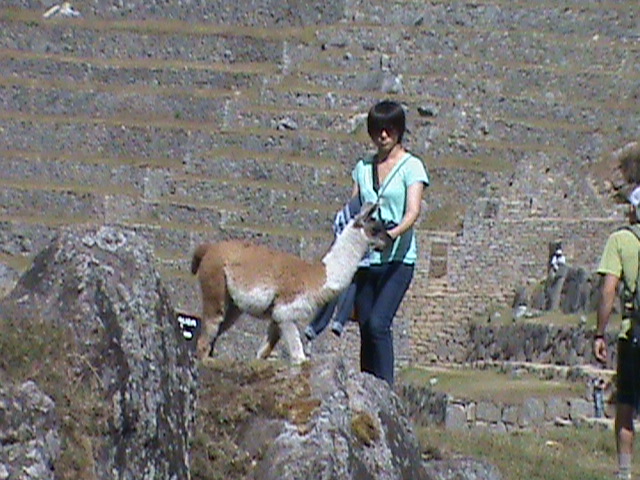
  Machu Picchu, in the Quechua language, means "Old Peak".  It is 7,970 feet above sea level.  Located 50 miles northwest of Cusco, we now know it was meant to be an estate for the Incan emperor Pachucuti ( 1438-1472). Incan emperors often had estates away from their main ruling cities. Sort of like their own huge Camp David.
The actual Machu Picchu peak.

Huaynu Picchu (young peak)


  The Incas started to build the estate around 1400 A.D.  They abandoned it as an official site for the Inca rulers over a century later during the Spanish Conquest.  The Spanish never learned of the site.  Because of this, the site remained in excellent condition without the violation and graffiti that the Spanish rendered on other Inca sites.
 
   The following designations have been given to Machu Piccu:
  • 1981 - Peruvian Historical Sanctuary
  • 1983 - Unesco World Heritage Site
  • 2007 - One of the New Seven Wonders of the World
  • 2008 - World Monuments Fund Watch List.
  • Currently under review with Unesco as a "World Heritage Site in Danger".
Possible Early Visitors

  While Hiram Bingham was the first to bring outside attention to Machu Picchu in 1911, he may not have been the first outsider to get there.

   Maps found by historians show references to Machu Picchu as early as 1874.  While not completely proven, there are claims that Machu Picchu was visited by Christian missionaries, Thomas Payne and Stewart McNairn in 1906.  Others may have visited in 1901 to leave their names etched in rock. I actually saw these names, and attempted to photograph them, but could not get close enough.  The area is roped off.  In 1867, German Augusto Berns may have discovered and plundered the site.  Thee is evidence that another German, J.M. von Hassel arrived even earlier.

   And then there are the extraterrestrials.  Given that some people believe the mysterious Nazca lines, near the town of Nazca, in southern Peru are the work of aliens, maybe they visited Machu Picchu, too!

Hiram Bingham and the Yale University Controversy

  Hiram Bingham was a history lecturer at Yale University.  He had visited Peru several times in search of the city of Vilcabamba, the last Inca refuge during the Spanish conquest.  in 1911, 11-year-old Pablito Alvares, a local Quechuas boy, showed Bingham the site of Machu Picchu.  There were local Quechuas people living in the original structures.  Bingham called the complex The Lost City of the Incas.  He made his discovery public to the world on July 24, 1911.  He made several more trips through to 1915, collected several artifacts, and wrote several books on the subject.

  Ceramic vessels, silver statues, jewelry and human bones were just a few of the artifacts excavated and taken by Bingham back to Yale University.  His study period was to be 18 months, and then he would return everything.  However, Yale took possession of the lot, probably with Bingham's approval.  According to Yale, Peru did not have the proper conditions or infrastructure to care for the pieces. Many of these pieces are on display at Yale's Peabody Museum.

  By 2007, Yale and Peru reached an agreement concerning the return of the artifacts.  Some actually have been returned.  A new museum and research facility would be built in Cusco.  Yale would be in charge of the research and help the Peruvians with the museum. This has not happened.  Not much happened on Yale's end of the deal. In fact, Yale has been a tad defensive about the situation.  They have a website about myths concerning the artifacts.  According to them, Peru's civil code of 1852, which was still in place when Bingham visited, allowed him to take artifacts.

   By November 2010, Yale agreed in principal to return all artifacts to Peru.

The Fate of  Machu Picchu

  Tourism is harming Machu Picchu.  There is no doubt about it.  As a tourist, I do feel guilty about leaving my carbon footprint.  The town of Aguas Calientes sits in the valley under the ruins.  Its sole purpose is to take care of tourists. The Unesco Foundation, and World Monuments Fund are studying the situation.  Peru is highly dependent on the tourist trade, and Machu Picchu is its crown jewel - but at what cost?  My goal is to find out what I can do to save this site.

   Peruvians have taken a good stand in protecting the ruins.  When a proposed helicopter landing pad was proposed on the main green of Machu Picchu, an outcropping of rock was removed to make way.  However, the pad was never built, thanks to environmentalists, Peruvians, and groups like Unesco. The well-to-do have to ride the tourist buses with the rest of us unwashed masses!

Enjoy the pictures.


Saturday, June 18, 2011

Salt of the Earth

Our next day in Peru would take us into the Sacred Valley, where we would visit the markets in the town of Chinchero.  We also had the option of visiting ruins and salt mines.  We would end our day in the town of Ollantaytambo.

Chinchero

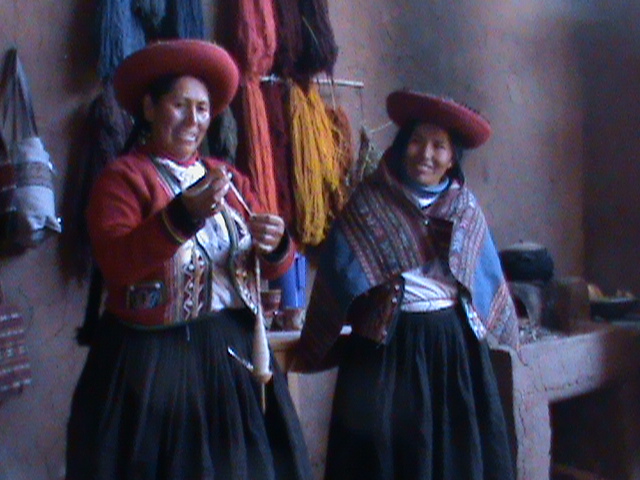
Chinchero is a town with a population of 900 (my guide book) to 5000!(Our native guide).  Our first stop was the Centro de Textiles Tradicionales.  The women here are working with surrounding communities to keep the old ways of dying and weaving. One of the women can speak fluent English, and has been to the United Nations to testify on behalf of keeping traditional weaving practices.  She would explain to my group of nine how wool is gathered from sheep, alpaca, and vicuna.  She showed us how they used the soap plant to wash the wool, and how it was spun on a spindle.  As someone who has cleaned, spun and dyed my own wool, I would further elaborate on her methods to my group.  She would then show us the various plants, insects, and ground stones that were used to dye wool, and the use of various mordants to fix the color and get various shades and tints. (A mordant fixes the dye to the wool so it does not fade quickly - although all colors fade in time.  Different mordants will change the colors from dark to light, etc.  Also, the kind of pot used to dye in, from cast iron to plastic, will affect the mordant.  It is a fun chemistry.)  When one of my group members asked why she did not use a spinning wheel - while that was being translated to her - I explained I also learned on a spindle, and that you can take a spindle anywhere, whereas a spinning wheel is stationary.  She would say the same.  She was aware of spinning wheels, but that she knew of no one who owned one.  We all bought something from these women, and when asked if I would bargain for another group member, I declined saying that I never bargain with women at a center where traditional methods are being used.  They need the money to preserve their ancient methods.  One of the ladies took  such a liking to me as a fellow dyer, that I scored a free scarf!


Various natural dyes.


Showing how the dyes and mordants work. 

Hand weaving


Who wouldn't have fun shopping?


After leaving the weavers, we would walk through Chinchero, which was a village started by the Incas.  Several of their buildings, including the local Catholic church, are built on Inca stones.

This Colonial church is built in Inca ruins.  

The switchbacks on this mountain are the only route to a neighboring village.  There is no car access.

Ruins in the foreground, but a careful look show a red satellite dish!

This woman is dehydrating potatoes.

Frescoes on the outside of the church.

Inca ruins

The Salt Pans

After Chinchero, we went to lunch in the town of Urubamba.  I had my first taste of alpaca meat, and it was yummy!  Alpaca, Llama, and vicuna are members of the camelid family.  Since I have eaten camel in the Middle East, I had no problem eating Alpaca. Llama is mostly a beast of burden, and is not usually eaten.

After lunch, we were given a choice of going on to Ollantaytambo and visiting the Inca ruins there, or going to the salt pans.  I had seen pictures of the salt pans in a recent National Geographic Magazine, and I made a case to my group.  We were not disappointed.
The salt pans from a distance.

One of the most beautiful sites in the entire Sacred Valley is the salt pans of Maras.  A hot spring at the top of the valley bubbles up with  heavily salt-laden water.  The water is diverted into literally thousands of pans, where the water evaporates, leaving salt.  This practice has been done since Inca times.  The salt pans have a fascinating look about them, reminding me of the travertine pools in Turkey.


Hot salty spring water making its way down.


I thought I was smiling.

While, there were other tourist groups there, we were the only one that actually went down into the salt pans, via a very narrow path, and our sure-footed guide, Vidal.

After the salt pans, we went on to the ruins of Moray, which no one knows for certain what the Incas where thinking when they built these terraces.  The current theory is that is was a kind of green house for experimenting with different crops.  The Incas did not leave a written language, but they did have some  kind of iconography, as they had a kind of pony express using runners to go from city to city with messages, and someone had to know how to read and write that iconography.

The terraces of Moray.

Ollantaytambo

This small town of about 700, has been inhabited since the 13th century, long before the Spanish arrived. Two massive Inca ruins dominate this small town.  We hit the town as the Pentecost holiday of Chockikillka was getting under way.  This was awesome, as old indigenous beliefs weave in and out of Catholicism.  I did not get to take as many pictures as I would have liked as the sun was sinking fast.  They had bands, and people in costume marching around the main square.  I would have loved to stay two days in this town to see this festival.
The baker girls are wearing masks.


After we checked in, a few of us went to dinner with our guide, Vidal.  We had second story views of the main square for when the fireworks went off.

The next day, we would take the Perurail train to Agua Calientes (Hot Water), the closest town to Machu Picchu.

Friday, June 10, 2011

Cusco - Navel of the Earth

Sometime around the 12th century A.D., the god, Inti, looked down on Earth and found the people in need of some serious organization.  So, the first Inca, Manco Capac, and his sister-wife, Mama Ocllo were created on Isla Del Sol (Sun Island) out on Lake Titicaca.  Manco Capac was given a golden rod.  Inti instructed him to find a place where he could plunge the rod into the ground until it disappeared.  This place would be the world's navel or qosq'o in the native Quechua language.  Manco did as he was told, and obviously, he had a long walk from Lake Titicaca to find this place. He subdued the local natives, and founded the longest inhabited city in South America: Cusco.

Incan history is fairly well documented, first through oral history, and then with the writings of Garcilaso de la Vega, the son of an Inca princess and a Spanish military captain.  The Spanish entered Cusco on November 8, 1533 headed by Francisco Pizarro.  The Spanish kept their own chronicles and history, and added Inca history as it was told to them.

Cusco, a mixture of Inca and Spanish traditions, is a vibrant city of about 400,000 people.  It is a city that is not for the faint of heart.  If a person wants a spa vacation, this isn't the place! (Although, there are plenty of places to get a much needed massage!)  However, I am an adrenaline junkie, and  love frenetic places.  Cusco was like Heaven to me!

This is an example of Colonial (Spanish) architecture. For those of us who have lived in  the Middle  East, this is familiar architecture.  The Moors brought this to Spain
The architecture is a combination of Incan, Colonial (when the Spanish came), and modern building.  Many buildings are built on Incan ruins.  Several of the Catholic churches are built with stones pilfered from Incan temples and palaces.

Cusco sits at 11,000 feet above sea level.  I left Lima, which is at sea level, and was in Cusco in an hour - by jet.  By bus, it takes 24 hours of driving through the Andes.  I could feel the lack of oxygen as soon as I got off the plane.  As I type this, I still have a splitting headache, despite my Tylenol,  Gatorade, and two servings of coca tea-yep, I have cocaine in my system! (Not only did my pulmonologist insist I bring my sleep apnea machine, she also insisted on using the coca tea within reason.  It tastes like an herbal tea, and I am not high. I have asthma, and the last thing I need is to end up in the hospital.)

La Catedral
I met up with my group of nine people, and we went with our guide to have lunch and to see a nearby cathedral- known as La Catedral. The Spanish started to build this church in 1559. To either side of this cathedral are the churches  of Iglesia del Triunfo (1536) and  Iglesia de Jesus Maria (1733). I was not allowed to photograph the interior, but it was very beautiful and ornate. The above mentioned  Garcilaso de la Vega was born in Cusco in 1539 and died in Cordoba, Spain in 1616. In 1978, King Juan Carlos of Spain had his remains returned to Cusco, where they are interred in La Catedral. My biggest regret is not buy postcards of the interiors of these churches as we left them.  A few days later, when we returned to Cusco, the postcard vendor was nowhere to be found. One of the paintings we found was of the Last Supper with cuy (guinea pig) as the main meal.  Serving cuy as a holiday meal is an important part of Quechua culture, and this painting was done by a native Quechuan.
Detail of Iglesia del Triunfo

Outside the cathedral, a festival was going on.  Children from different groups-schools were dancing in native costumes.  Women were selling handmade items, and I got a chance to practice my bargaining skills, getting two presents at a very nice price.  By this time, we all went our separate ways.  I went back to the hotel to blog.


I am told it does not snow here.  While we are high, we are also close to the equator.  The days seldom get above the sixties, and the nights are almost always freezing.  The next morning as I was walking through the hotel courtyard, I could see my breath.

Tomorrow, we leave for the Sacred Valley.

party plane

i am typing this post on a peruvian keyboard, and i haven´t figured out how to do capitols.  capitals?

my journey to peru would start in salt lake city, then on to atlanta, and then on to lima.  i had a three hour layover in atlanta.  after getting from my arrival terminal to my departure terminal, i had lunch with two utahns that i met in salt lake who were also traveling to lima, and on to cusco.

the flight to lima was entertaining to say the least.  we were delayed about 30 minutes on the tarmac due to wind.  the pilot would later inform us that we were one of the last flights out before the airport was closed to to bad weather.


the lady in front of me was 76 yrs old, and on the same tour as the teachers.  she was a retired stewardess for delta.  notice i said stewardess.  she rolled her eyes at the term flight attendent.  the lead flight attendent also stated she was a stewardess and then amused us with stories of when she was first starting out.  she had to wear a wig and tuck her long hair under it.  she also had to wear a girdle, and was pinched by her female supervisor to make sure she was wearing it.


anyway, we watched glee together.  the retired teachers told me they wished they could get away with some of the stuff sue sylvester says to the students.

we arrived in lima about midnight.  after passport control, luggage-which took a long time, and customs, i was able to walk across the street to my hotel, take a shower and get some much needed sleep.

today, i am on to cusco!

Wednesday, June 8, 2011

The Sixth Grade Social Studies Book

     When I was in sixth grade, we studied South America.  I should really say we read about it, because I don't recall Mrs. Westover, my teacher, ever really teaching us.  But, I digress.

      One day I found a picture of Machu Picchu in the textbook.  The picture fascinated me.  I would look at it often and vowed to myself that one day I would go to Peru to see this place. And, I mentioned this to a few classmates, who laughed at me.  Twelve-year-olds can be so mean.

     "Some day" has finally come!  For about two years I have been planning and saving for a trip to Peru for my 50th birthday present to myself.  Since I have never been to this continent, and do not speak Spanish, or more precisely Quechua, I decided to go with a travel group.  I researched many, and settled on Adventure-Life.  I found a tour that was short, easy to save for, and would get me to Machu Picchu.

      Then I began the everlasting hobby of accumulating frequent flyer miles so that I could cash them in for a free plane ride.  The only planes I am paying for are LAN Airlines trips within Peru.

    And because I enjoy maps, please enjoy mine!


South America, and where Peru is on it.

I will fly into Lima (purple nail) and then fly onto Cusco.

Detailed map of the area I will be in.

Not so detailed map of the area I will be in.

Friday, April 1, 2011

Incredible Journey

I loved every moment I was in The Netherlands, and I will surely return.  I say good bye with a few videos of the hyacinth fields and a Deftware artist, and of the crooked houses along the Prinsengracht, where I stayed.

Painting Delftware


                                                             Hyacinth Fields from the Train


As I would walk down the street each day, I would notice the houses across the canal from me.  They seemed a bit crooked, like a person's teeth - first thing that came to mind.  I kept staring at them until finally I took pictures.  People actually live in these houses, and I wonder if things roll around in their homes.